Your First Two Weeks
The app hands you a dozen tools and trusts you to pick — which is lovely, unless you're brand new and have no idea what order they go in. Here's the order.
A quick promise before the plan: none of this is homework. There's no streak to protect and nothing resets if life gets in the way — the plan is a suggestion, not a contract. Ten minutes a day is plenty. Five counts.
And a word on what "beginner" means here: this plan works on a kit, on a practice pad, or on your knees at a kitchen table. Two of the four sections below don't need a drum at all.
Rule zero: start the click
On a guitar, every session starts by tuning. Drums don't go out of tune in that sense — but they do go out of time, and that's the same problem wearing a different hat. So rule zero here is: open Pulse and start the click before you play a note.
Pulse is Drum Buddha's metronome, and it gets its own permanent tab for exactly this reason — you'll open it more than anything else in the app. Set a tempo with the big readout, or tap the tap tempo button along to something in your head and let it work out the number. A row of beat dots lights up through the bar so you can see where you are, and visual pulse — a soft glow across the whole screen on every beat, brighter on the downbeat — is on by default, which means the click still works when your headphones die.
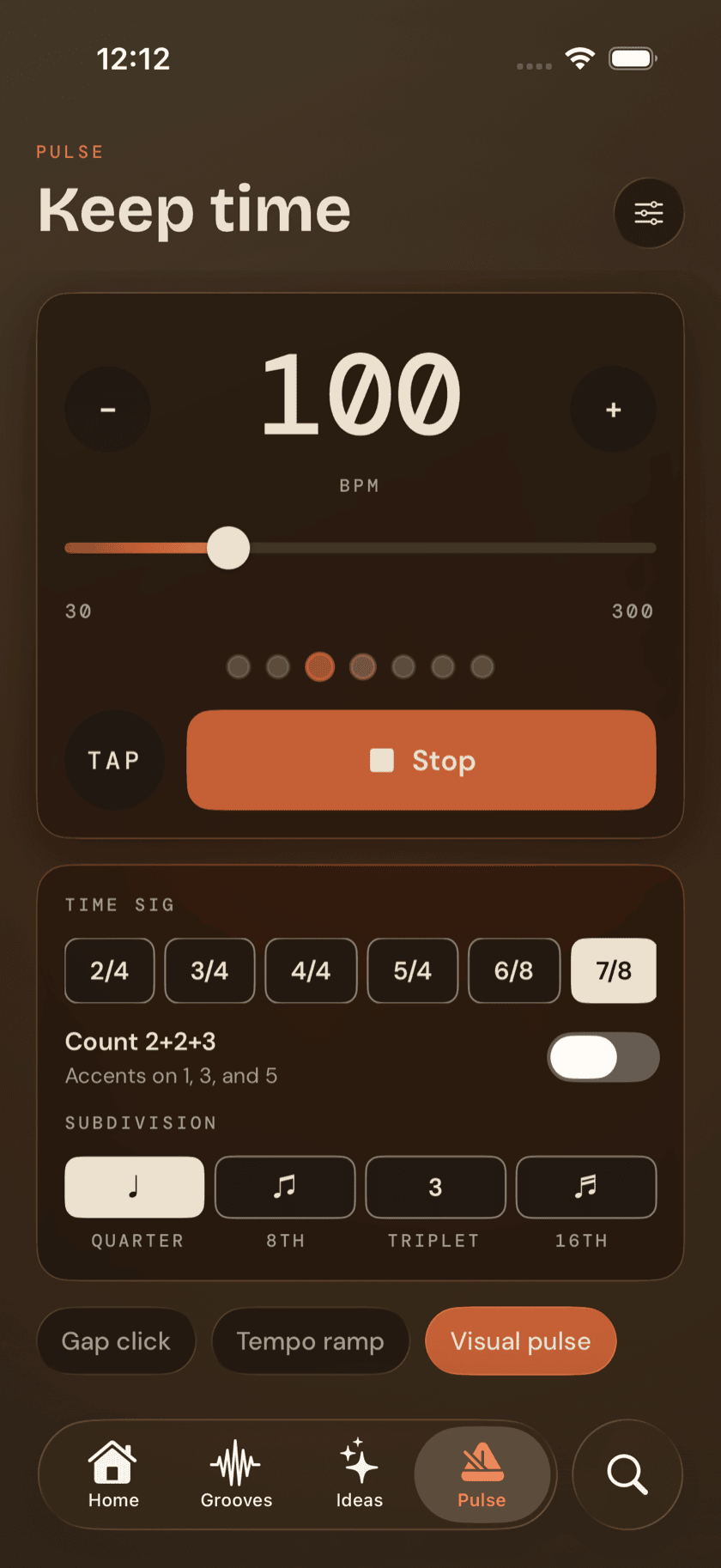
Pick something slow. Slower than that. Around 70 BPM is a good place to start almost anything, and playing something clean at 70 is worth more than playing it ragged at 110. The Pulse page covers every control, and the journal's metronome guide covers what to actually do with one.
Days 1–3: one groove
Open the Grooves tab and filter the style pills down to Essentials. You're after the money beat — the eighth-note hi-hat, kick on 1 and 3, snare on 2 and 4 pattern that the first-run walkthrough already showed you. It is, by a wide margin, the most-played bar of music in existence. Learn it and you can sit in with almost anything.
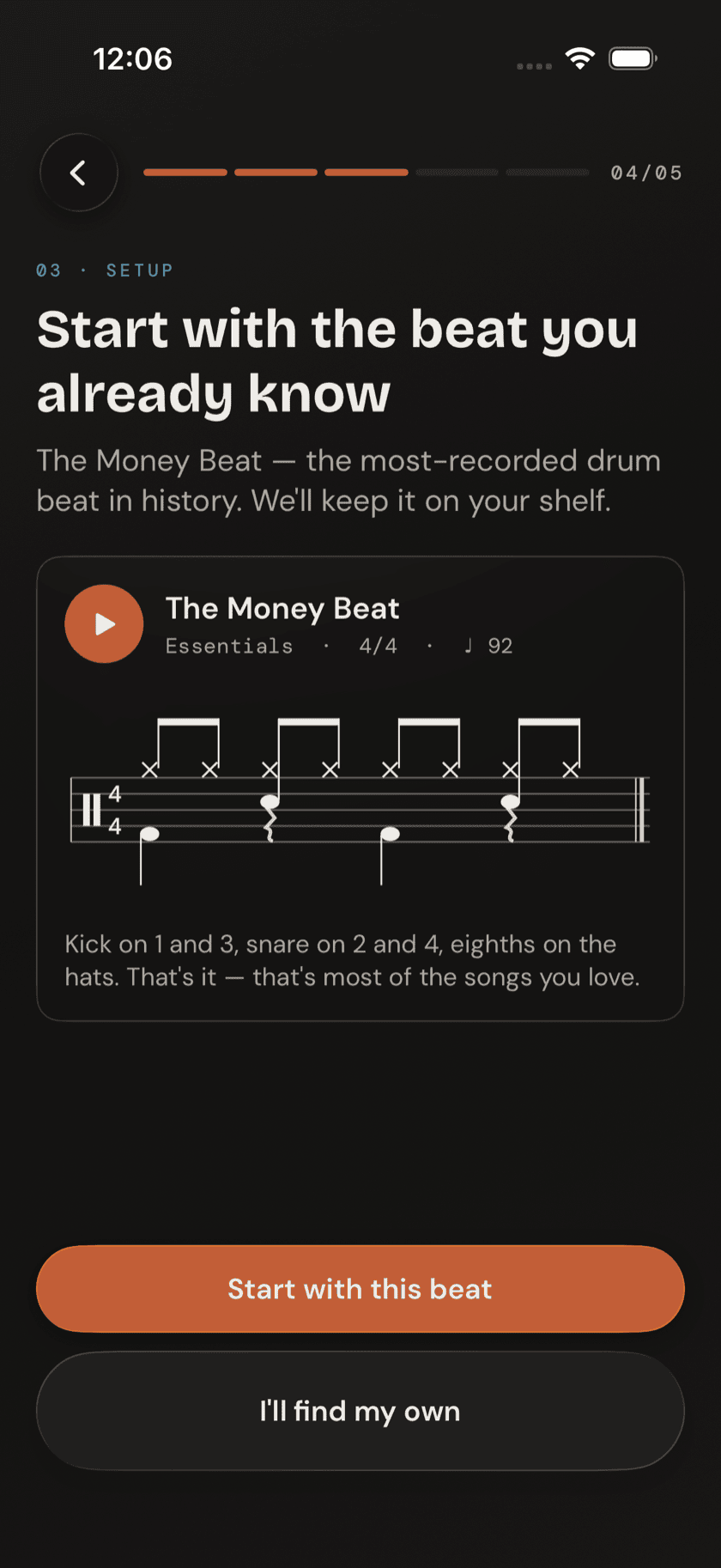
Tap into it and the detail page is where you'll live: notation across the top with a playhead tracking the beat in real time, a transport underneath, and a toggle that flips the staff into grid view — voices down the rows, subdivisions across the columns, each hit a dot. If you can't read notation yet, use the grid; it shows the pattern's shape immediately. If you'd like to learn, keep the staff up and let the playhead teach you what you're looking at.
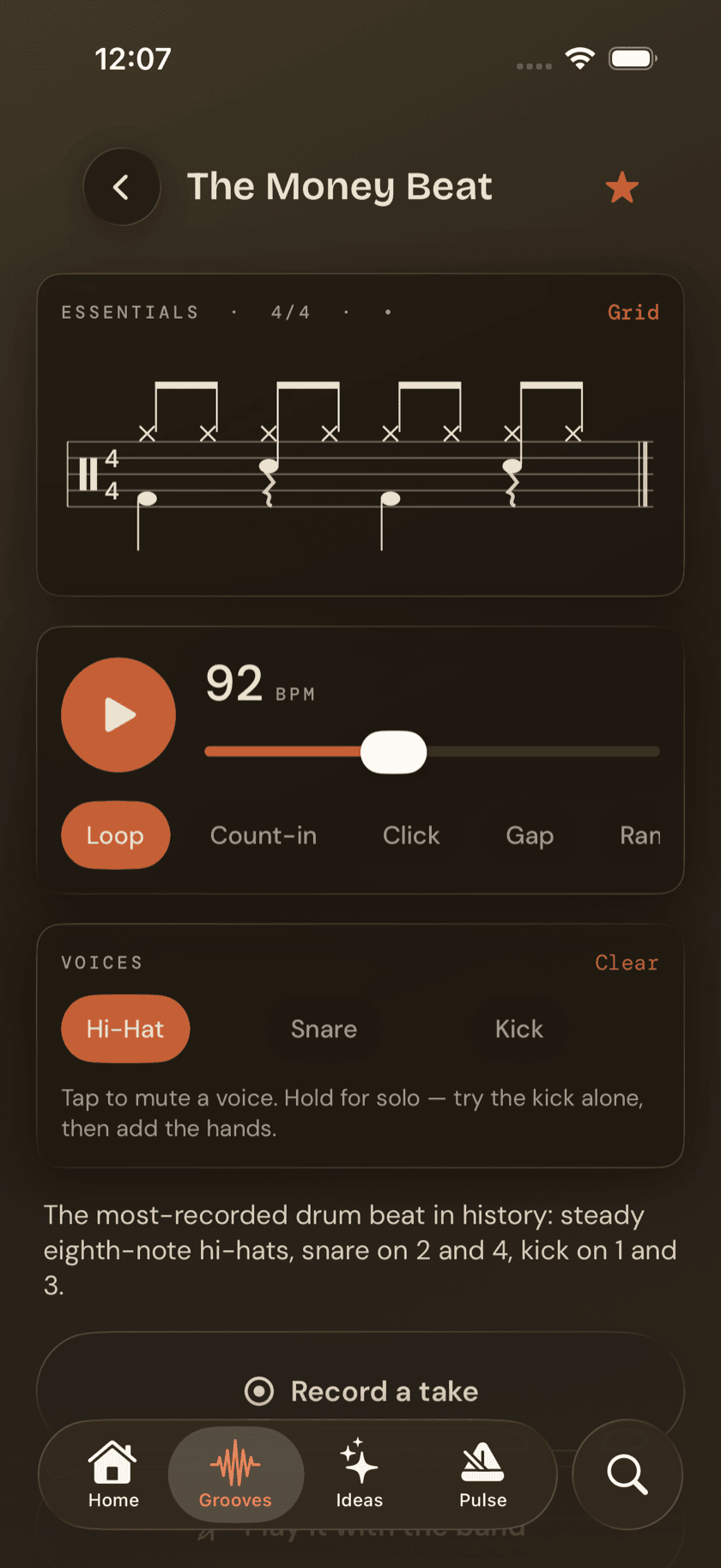
Turn on Count-in and Loop, drag the tempo well down, and play along. The BPM readout has a Reset button sitting next to it once you've moved the slider, so there's no hunting your way back to the default.
Then use the one tool on that page that does more for a beginner than anything else: the voices card. Tap a voice to mute it, hold to solo it. Mute the hands and play just the kick and hi-hat foot until it's steady. Then bring the hi-hat back. Then the snare. You're stacking one limb at a time instead of trying to absorb three at once — and the full notation stays on screen the whole time, so you can still read the part you've silenced.
Three days on one groove sounds like a lot. It isn't. The Grooves page covers the rest of that screen, and the journal's first grooves article covers which patterns to add after this one.
Days 4–7: singles and doubles
Now put the kit down for ten minutes a day. This part is a pad, a pillow, or your thighs.
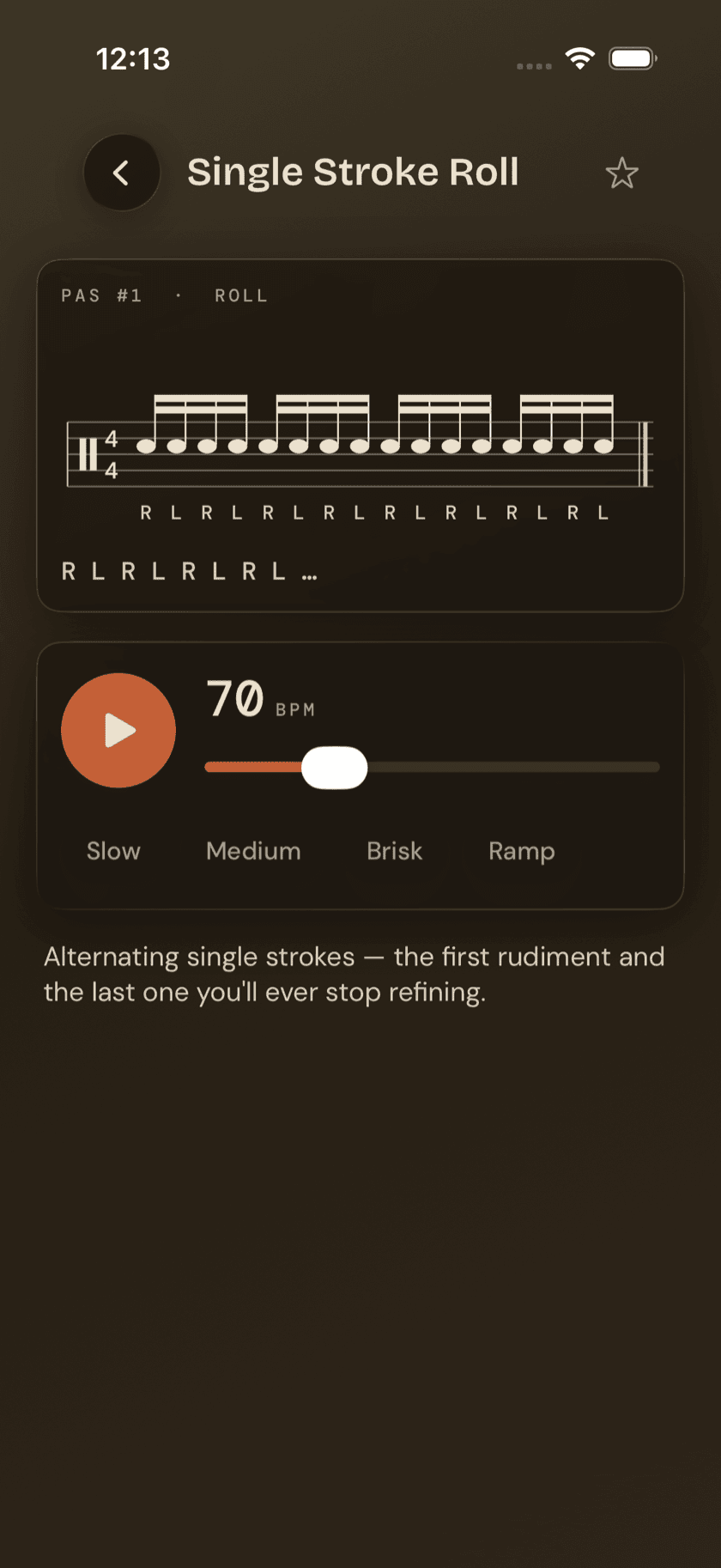
Open Rudiments. There are 40 of them and you need exactly two this week. From Rolls, take the Single Stroke Roll — alternating R L R L, the first rudiment and the last one you'll ever stop refining. From Diddles, take the Single Paradiddle — R L R R, L R L L. That's it. Star them both so they pin to Favorites and the other 38 stop shouting at you.
Each rudiment opens the same way: notation up top with a moving playhead, and a sticking line underneath spelling out R and L under the notes they belong to, so you're never guessing which hand. Three pace pills — Slow at 55, Medium at 80, Brisk at 110 — jump the tempo without touching the slider. Start on Slow and mean it. Tap Ramp and the tempo creeps up on its own through the session, about 30 BPM by the end, so you get faster without ever deciding to.
There's no microphone here and nothing scoring your hands. A mic can't reliably tell a clean paradiddle from a sloppy one through a drum's overtones, so Rudiments doesn't pretend to — it shows the notation, keeps time, and lets you judge. Which means the honesty is your job. Play it slow enough that you can hear both hands sounding the same, and you'll get there faster than by chasing the ramp.
By the end of week one you have one groove and two stickings. Put together, that's most of a drummer. The Rudiments page has the full catalog for when you want more.
Week two: your first fill
This is the part the whole first week was for — the moment the groove stops being an exercise and starts being music.
Open Fills. It's the same library and the same detail screen as Grooves, filtered to the 30 patterns whose job is to move you somewhere rather than hold you in place. Start at the easy end: Quarter-Note Toms, or Beat-Four Snare Fill — a single bar, four hits, nothing clever.
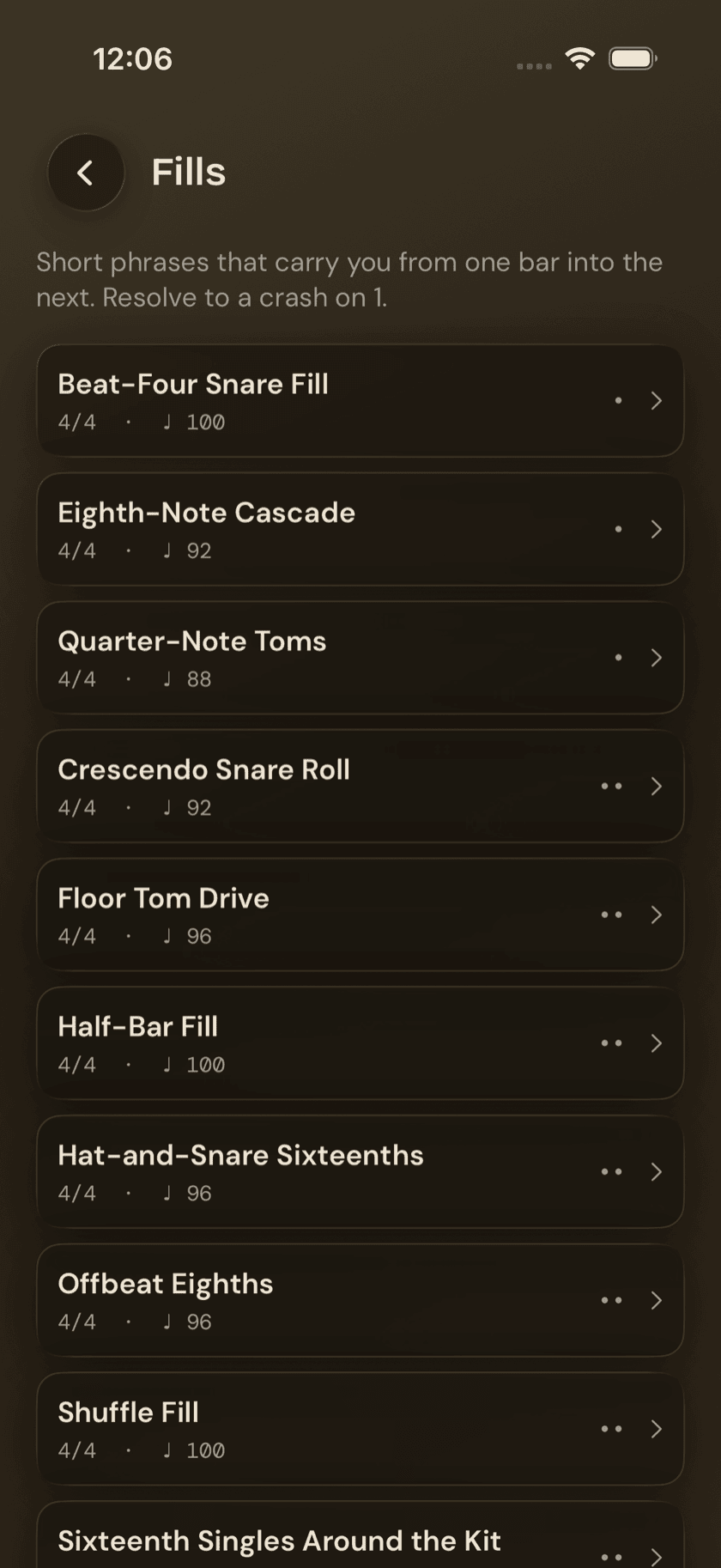
Learn it on its own at a slow tempo. Then do the thing that makes it a fill: play three bars of your money beat, one bar of the fill, and land back on beat 1 — on a crash if you've got one. Three and one, over and over. That four-bar phrase is the structure underneath a startling proportion of recorded music, and once your hands can do it you can play along with actual songs.
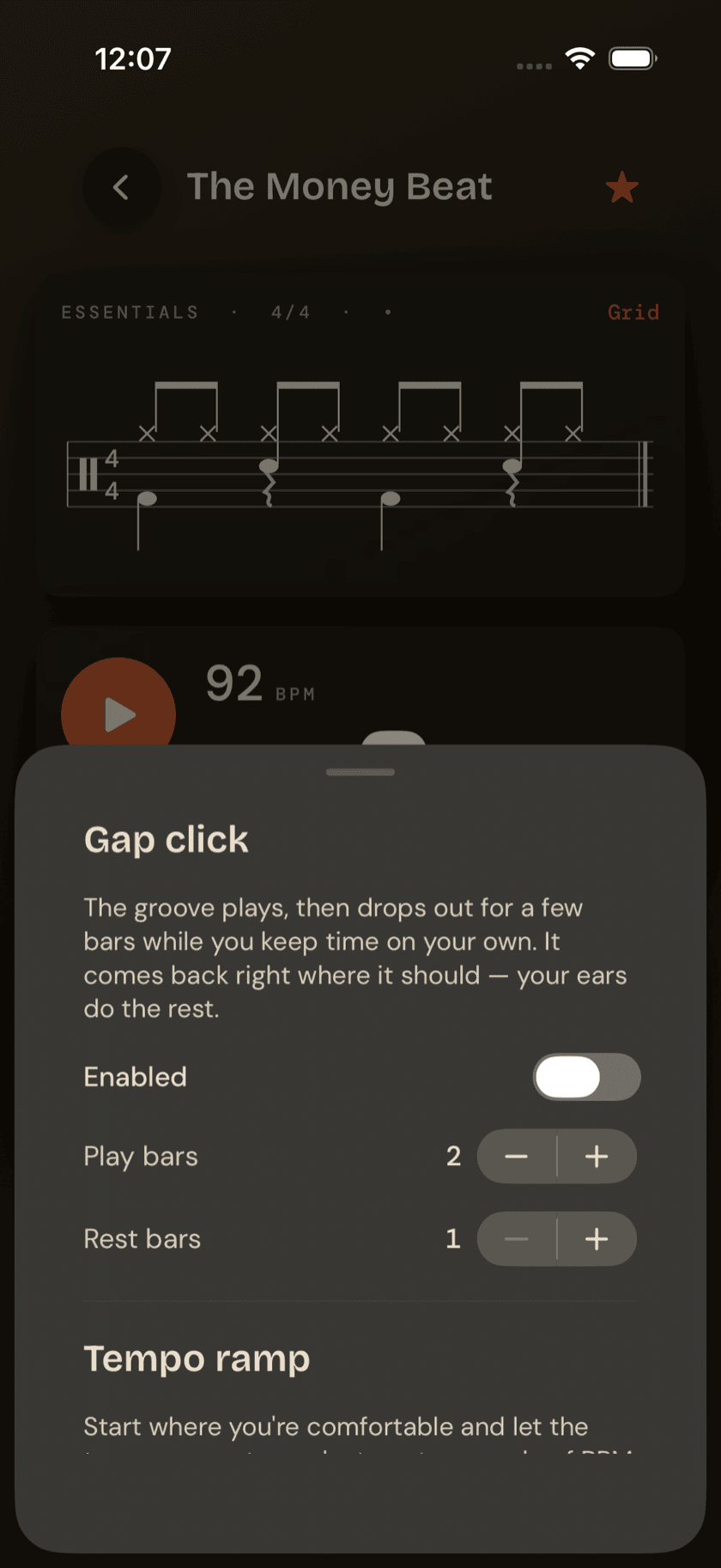
When it's holding together, go back to the groove and turn on Gap click — a practice sheet with two steppers, play-bars and rest-bars. Set it to play two and rest two. The groove drops out, you keep going, and it comes back in exactly where it should. Either you're still with it or you aren't, and there's no arguing with the answer. It's the most useful two minutes in the app.
There's no penalty hiding anywhere in this. Skip a day, skip four — the app keeps no streak, sends no guilt, resets nothing. Two weeks of ten-minute sessions beats one heroic Saturday, but the app will never say so out loud.
What to ignore for now
The fastest way to stall in week one is opening everything. All of this is good, and none of it is for right now:
- The other 38 rudiments — flams, drags, ratamacues, seventeen-stroke rolls. They're a two-year project, cheerfully waiting.
- Coordination — limb independence drilled on its own. It's the right tool for exactly this problem, later. Muting voices on your one groove is enough of it for now.
- Odd meters — 5/4, 7/8, the 2+2+3 toggle. Wonderful, and completely beside the point until 4/4 is automatic.
- The groove editor — building your own patterns is much more fun once you can play a few of somebody else's.
- Loops and Jam — the band can wait a week. Pulse and the groove's own count-in keep time for you until then.
Everything on that list will still be there in week three. That's the whole design.
When two weeks are up
If you've kept time, held a groove, drilled two stickings, and landed a fill on beat 1 — you're no longer a day-one beginner, and the rest of the app starts making sense on its own. Three natural next steps, in rough order:
1. Make the plan a routine. Routines chains what you've been doing by hand — click, groove, rudiments, fill — into one guided, timed session you start with a single tap.
2. Split your limbs up properly. Coordination is where the muting trick becomes a whole practice category: ride ostinatos, kick patterns, and snare comping stacked one layer at a time.
3. Just jam. Jam gives you a full band — bass, keys, the lot — at your tempo, in your key, with a record button. Playing your money beat under actual music is a different feeling entirely.
And for the philosophy of what a single good session looks like — short, focused, ending on something fun — the journal's practice routine article is the companion piece to this page: this one told you which tools; that one explains how it stays a habit.