Rudiments
All 40 PAS standard rudiments, notated and playable at your tempo — a library and a player, not a judge.
Rudiments are the sentences drumming is built from — the vocabulary the Percussive Arts Society settled on as the standard. Drum Buddha has all 40 of them, notated, with a sticking line under the music and a tempo you control.
What it isn't: a listening test. There's no microphone here, no correctness detection, nothing scoring your hands against the notation. You watch the playhead move, you play along, and you decide for yourself whether it was clean. That's a deliberate choice, not a missing feature — more on why below.
What's in the library
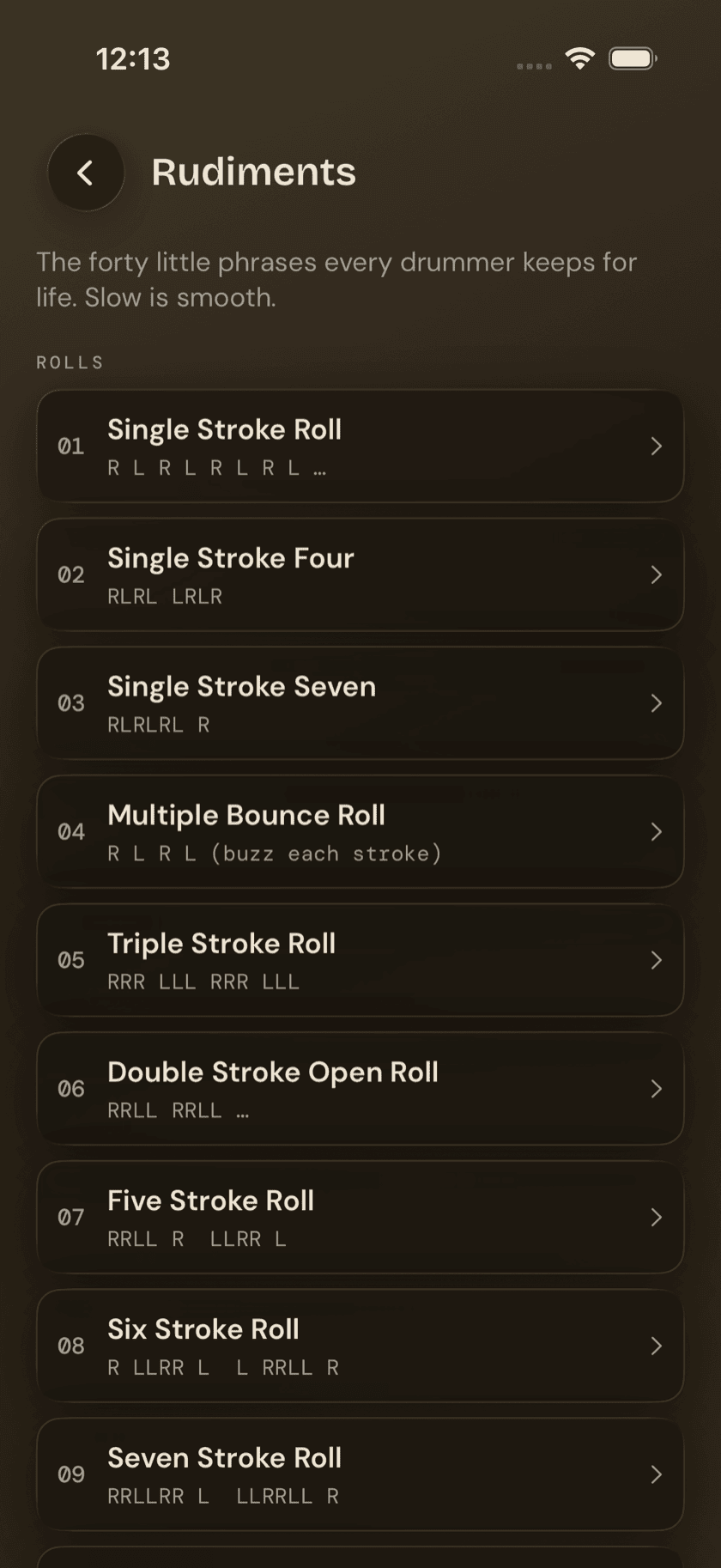
Open Rudiments and you get four sections, one per PAS category: Rolls, Diddles, Flams, and Drags. Favorite anything and it pins to a Favorites section above the four, so whatever you're actually drilling this week doesn't get buried under the other 36.
- Rolls (15) — the roll family, from Single Stroke Roll through the Seventeen Stroke Roll. Single Stroke Four, Single Stroke Seven, Multiple Bounce Roll, Triple Stroke Roll, and Double Stroke Open Roll live here too, alongside the odd-numbered stroke rolls — Five, Six, Seven, Nine, Ten, Eleven, Thirteen, Fifteen, Seventeen.
- Diddles (4) — Single Paradiddle, Double Paradiddle, Triple Paradiddle, Single Paradiddle-Diddle.
- Flams (11) — Flam, Flam Accent, Flam Tap, Flamacue, Flam Paradiddle, Single Flammed Mill, Flam Paradiddle-Diddle, Pataflafla, Swiss Army Triplet, Inverted Flam Tap, Flam Drag.
- Drags (10) — Drag, Single Drag Tap, Double Drag Tap, Lesson 25, Single Dragadiddle, Drag Paradiddle #1 and #2, Single, Double, and Triple Ratamacue.
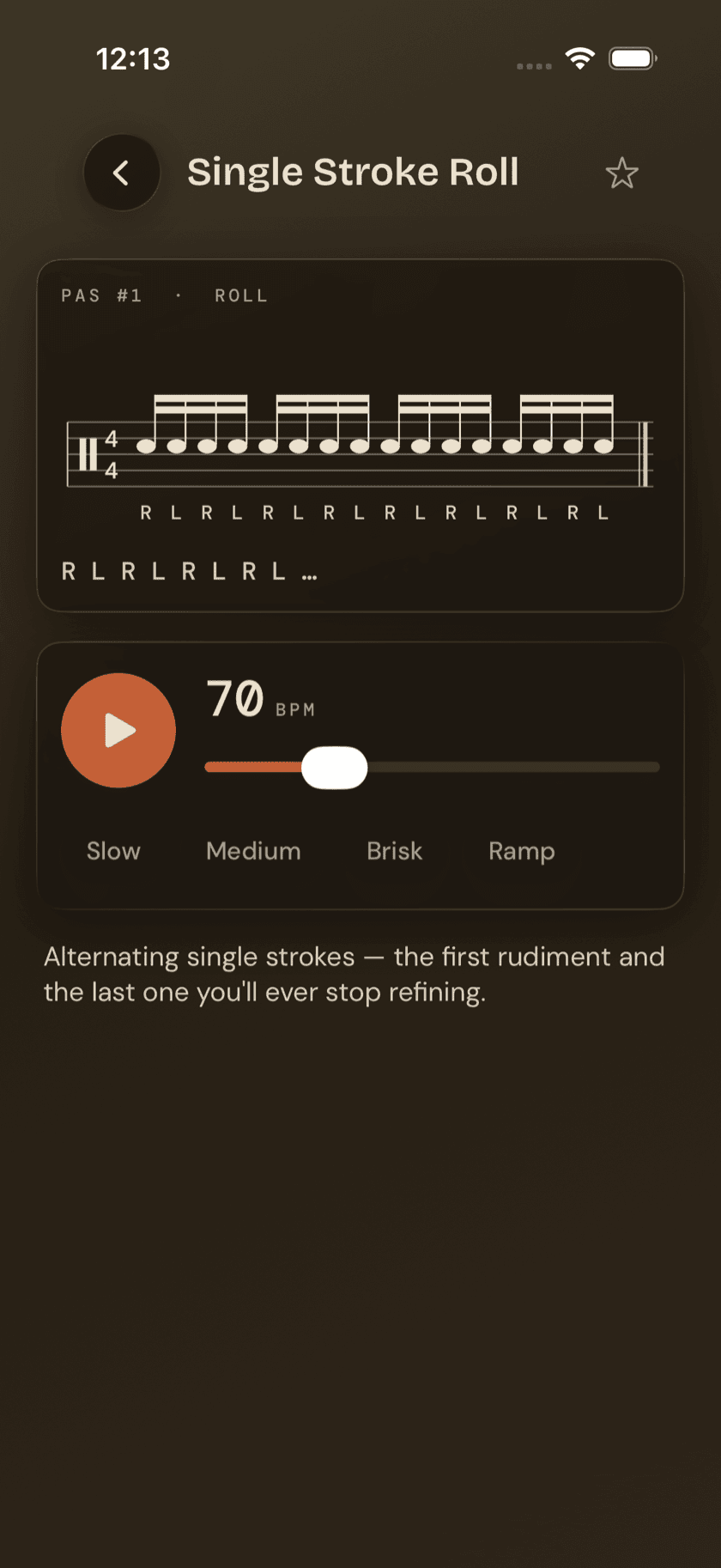
Each rudiment carries a one-line description, plain enough that you don't need a drum dictionary open in another tab. The Single Stroke Roll's, for instance: "Alternating single strokes — the first rudiment and the last one you'll ever stop refining."
Opening a rudiment
Tap into any rudiment and the layout is the same for all 40: standard notation across the top with a playhead that moves as it plays, and a sticking line underneath — the R/L pattern spelled out under the notes it belongs to, so you're never guessing which hand.
Below that, a transport: play/stop, and a tempo slider running 40 to 160 BPM. Three pace pills sit next to it for quick jumps without touching the slider — Slow (55 BPM), Medium (80 BPM), Brisk (110 BPM). Tap Ramp and the tempo creeps upward on its own through the session — roughly a couple BPM every few bars, about +30 BPM by the end — so you can start slow and let it get harder without stopping to drag a slider yourself.
A star toggle favorites the rudiment, pinning it to the Favorites section back on the library screen.
A microphone can't reliably tell a clean paradiddle from a sloppy one — not at speed, not through a drum's overtones. So Rudiments sticks to what it can do honestly: show the notation, keep time, and get out of the way. You watch, you play, you judge.
Ramp only pushes tempo up during a session, never down. Stop and restart the rudiment to reset it to wherever the slider or a pace pill last left it.
Sit down and play.
Learn grooves, capture ideas, jam with a live band, and keep time — free, local-first, on iOS & iPadOS.
Explore Drum Buddha →